

Vietnamese architecture in the past carried many traditional characteristics, closely associated with natural materials such as bamboo, rattan, wood, bricks, sand, and stone. Today, the construction industry has grown significantly. So, can sandwich panels replace those traditional materials?
In earlier construction, people mainly used simple natural materials because of their availability and familiarity. Over time, due to increasing needs and requirements to adapt to natural and social conditions, materials like bricks and tiles were created. People bonded them using lime or gypsum. Later, new binding materials were developed, such as air-hardened lime mixed with active additives. By the early 19th century, Portland cement was invented, and during this period, metal materials and reinforced concrete also began to be produced.
From 1945 until now, starting from traditional building materials, the construction materials industry has introduced hundreds of new categories with diverse designs, sizes, and colors to meet domestic construction needs and export demands.
Following the development of construction materials, the architecture of industrial factories has also evolved—from workshops made of straw mixed with mud, to wooden structures with brick walls, to reinforced concrete factories, and today, modern steel-frame factories using sandwich panels.
Traditional factory structures using reinforced concrete with on-site formwork were the most widely used for a long time. This method allows flexible architectural shaping, meeting the decoration and design needs of investors. Concrete also has good load-bearing and high weight capacity.
However, this architectural style only allows a typical span of about 30m for single-story factories and about 10m for multi-story buildings—meaning low span capability. Construction progress is slow as all stages must be done on-site, making quality control difficult. When expansion or upgrading is needed, drilling, chiseling, and additional pouring are required, affecting production activities and compromising overall quality.
Therefore, traditional materials in Vietnamese architecture are being improved to suit modern economic and social conditions. In parallel, new materials with superior characteristics have emerged. Sandwich panels are an advanced type of material, enhancing advantages while overcoming limitations of traditional materials.
Sandwich panels meet high technical requirements such as durability, sound insulation, and thermal insulation, while providing rich inspiration for architects to create innovative designs. With trends favoring energy-saving, soundproof, heat-resistant, and eco-friendly building materials, sandwich panels align perfectly with Vietnam’s development orientation.
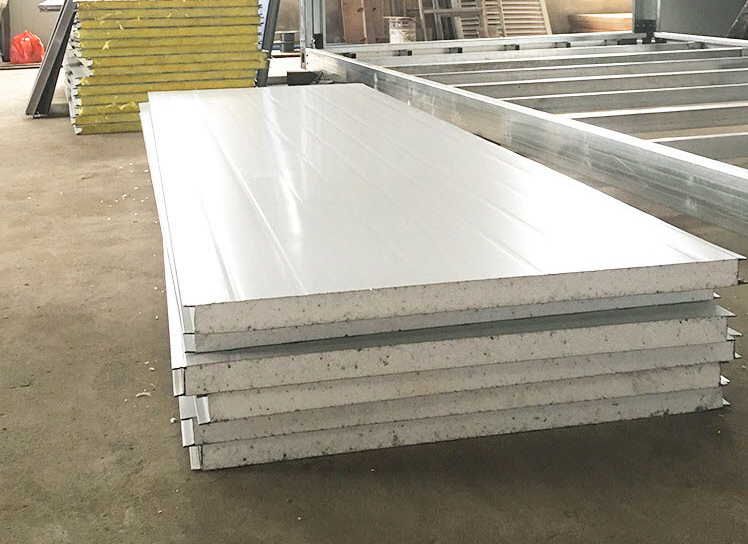
A sandwich panel consists of three layers: two outer surfaces made of color-coated galvanized steel, and a core layer made of EPS or PU. This structure provides excellent soundproofing and thermal insulation.
The outstanding advantages of sandwich panels lie in their soundproofing and heat insulation, thanks to the metal layers and a core with a high melting point. This helps significantly reduce cooling costs. Therefore, sandwich panels are widely used in cold storage, cool rooms, seafood preservation warehouses, food processing plants, restaurants, and supermarkets. They are also used in laboratories, medical cleanrooms, and electronic component manufacturing facilities.
Sandwich panels also have high load-bearing capacity. With sturdy metal outer layers combined with the density and thickness of the core, the panels withstand loads many times greater than their own weight. Unlike plastic or wood products that warp under weather effects, sandwich panels maintain high mechanical strength and tightness. Thus, they are suitable for roofing, walls, and protective cladding.
Their modular connection system makes installation and dismantling quick and easy. With a maximum length of 18m and lightweight characteristics, they save labor and ensure fast construction.
Construction costs using sandwich panels are 30–40% lower than traditional materials like bricks, wood, iron, and steel. Sandwich panels are also reusable and have a lifespan of 30–50 years. With diverse types and colors, they enhance aesthetics. Since they do not require loose materials like sand, gravel, or cement, they are environmentally friendly.
Sandwich panels are increasingly popular and are becoming the top choice for investors, replacing traditional materials in both industrial and residential projects.